
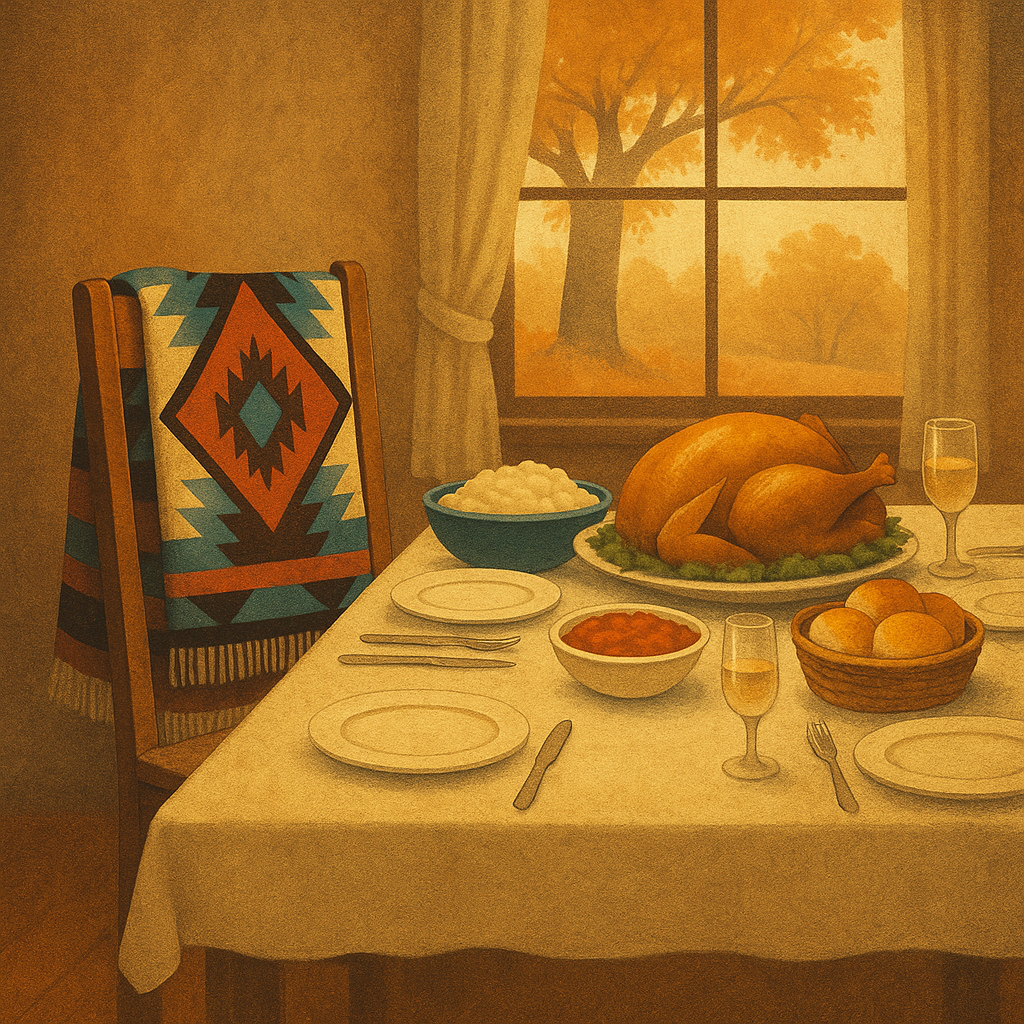
An empty chair. A reminder that every celebration sits on a layered story - joy braided with histories we cannot ignore. Reflection is its own kind of gratitude.
“Because leadership is a practice of facing truth — especially when it’s uncomfortable — and choosing actions aligned with our values.”
Imagine, just for a moment, that you grew up in a world where the truth was never tucked under the tablecloth. A world where the adults around you didn’t pretend the past was cleaner or kinder than it really was. Where history wasn’t rewritten to make anyone feel comfortable — but held open like a door you were invited to walk through with curiosity, humility, and courage.
Imagine you were raised in a town where stories were told whole - not sanded down, not softened - and where children learned early that love and accountability can share the same plate. A place where tradition wasn’t fragile, where admitting the brutality of our beginnings wasn’t seen as betrayal, and where the community taught you that reckoning with harm was part of honoring hope.
Imagine a family like this one I am about to share with you, where every holiday table made room for both celebration and sorrow. Where it was normal to name the atrocities committed against Indigenous people, and also normal to gather joyfully with the people you love. A family where no one had to pretend the past was anything other than what it was — and where the commitment was always toward doing better in the future. Imagine growing up like that. Imagine how differently we might all move through the world. I’ll share Lillian’s story and let you marinate on it.
Lillian’s family had a tradition. Every year, as the house filled with the glow of oven-warm air and the clatter of inherited serving spoons, one chair was left intentionally empty. No one sat in it.
It wasn’t for ancestors.
It wasn’t for symbolism.
It wasn’t for decoration.
It was a truth-keeper.
Before anyone picked up a fork, the youngest child would stand beside the empty chair and say, in their own words, why it was there: “This is for the people who lived here first. The ones pushed away. The ones who lost everything so we could live here now. We remember them.” The adults never corrected or polished their phrasing. That wasn’t the point. The point was presence. The point was remembering. The point was refusing to pretend. And then — they ate. They laughed. They celebrated. They found gratitude exactly where it lived: not in erasing the pain, but in honoring it honestly.
As Lillian grew older, that empty chair came to mean something more. It became a reminder that we can hold conflicting truths without collapsing. We can acknowledge harm and still allow joy. We can honor grief without forfeiting gratitude. We can stay awake to the past and still move forward with purpose. And most importantly — we can choose to be different stewards than the ones who came before us.
Why This Reflection Matters Now
Because we’re living in a time when it feels easier than ever to retreat into comfort. To pretend. To skip the hard conversations. To scroll instead of reckon. To reach for tradition without interrogating what’s underneath it. And yet — growth never comes from denial. It comes from the courage to sit beside the metaphorical empty chair and say, “I can hold this. I can look at the truth and still choose hope.” That’s leadership.
Leadership isn’t the sterile stuff people try to package it as. It’s the ordinary, human practice of tolerating complexity. Of staying curious in discomfort. Of choosing accountability over defensiveness. Of modeling what it looks like to make space for truth — even when the truth is heavy.
Why I Care — And Why I’m Writing About This Here
My relationship with identity has never been simple. I’m a white, cisgender, queer woman — someone who occupies both marginalized space and profound privilege. I grew up with identities that don’t always move together cleanly. One of my brothers is also Black, which means the emotions in my family about identity, bias, belonging, and truth were never theoretical. They were real. Emotional. Uneven. Human.
I’ve spent my career teaching leaders how to build psychologically safe teams, how to foster equity, how to navigate difference with integrity instead of defensiveness. And the truth is: none of that work sits in a vacuum. If I can ask hospital leaders to look at their team culture honestly, I can ask myself to look at our country’s culture honestly.
If I can help teams create environments where people belong, I can also challenge myself — and my community — to reckon with how we show up in moments like this season, when the sanitized story is so tempting. Talking about the real history of Thanksgiving, about Indigenous trauma, about the contradictions inside our national mythology, isn’t political.
It isn’t divisive.
It isn’t off-brand.
It is leadership.
Because leadership is a practice of facing truth — especially when it’s uncomfortable — and choosing actions aligned with our values.
A Closing Thought
As you head into this holiday season, maybe consider leaving your own version of an empty chair. Not as a performance. Not as guilt. But as an invitation — to reflection, to accountability, to gratitude that doesn’t require erasure. May this season give you room for all of it. And may we each become the kind of leaders who make space for truth, even when it complicates the feast.
💗 Stephanie